
Running a Sex Offender Check in Carter County
The Kentucky State Police Sex Offender Registry is the first public channel for a Carter County sex offender check. Searchers can use a name or geographic details and can narrow a broad result set to Carter County, Grayson, Olive Hill, or a known ZIP code. A name alone is not enough for a sound match. Compare the photo, aliases, physical traits, listed address, offense, conviction jurisdiction, and registration status before drawing any conclusion.
Local questions follow a different route. Carter County Sheriff personnel and KSP or Post 14 take part in registration, verification, and enforcement, but the county does not publish a separate local registry list, map, desk, appointment rule, or fee. Call before visiting. Use the state profile as the shared reference and ask the listed agency to explain a mismatch. For a person who may have moved across state lines, add the national search.
Searching Carter County in the KSP Registry
KSP manages Kentucky's public registry, while local law enforcement and Kentucky Department of Corrections staff help collect and verify registration data. That division of work matters in Carter County. The public portal is the search layer; the sheriff or KSP is the human follow-up channel. A portal result may show where a person is registered and whether a compliance issue is flagged, but it does not publish every underlying registration form, verification contact, or enforcement file.
Start broad only when details are scarce. A name search can find a known person, while address, city, ZIP, county, radius, and map or list controls support neighborhood awareness. Exact radius choices can change in the live interface, so use only what the portal displays. If the search returns no Carter County profile, try an alias or less name text, check spelling, and run the national search. No result proves only that the current query found no public match in that system.
Searching the Kentucky State Police Sex Offender Registry
A careful Carter County registry search uses the conditions displayed by KSP and a small set of known facts. Do not select a person merely because the name is close. Public records can contain aliases, similar names, prior addresses, and data that changed after the last verification. The four steps below keep the search tied to the official public profile.
- Open the KSP registry and read its conditions and misuse notice before using the search controls.
- Search by name when a person is known, or use address, city, ZIP, county, radius, or map controls for a place-based check.
- Filter to Carter County when appropriate, then compare the result list by photo, full name, aliases, and physical description.
- Open the full profile and review the address, qualifying offense, conviction details, registration status, and agency contact before acting on the information.
The registry research confirmed the following controls. Required status depends on the selected search mode, and the live portal controls exact options.
| Field Label | Type | Required | Notes |
|---|---|---|---|
| Name | Text | Mode-dependent | Uses first and last name; alias matching can vary |
| Address | Text | Mode-dependent | Supports a street, city, or ZIP-based search |
| County | Dropdown | No | Select Carter for a county-focused result set |
| City or ZIP | Text or dropdown | No | Use the official locality or ZIP |
| Radius | Dropdown | Mode-dependent | Use the distances currently offered by KSP |
| Map or list | View control | Not applicable | Changes how geographic results appear |
Carter County Registry Is Not Criminal History
A registry profile answers a narrow legal question: whether Kentucky currently makes a person's sex offender registration information public. It is not a full Carter County criminal-history report. The portal does not replace CourtNet, the Carter Circuit Court Clerk's signed case file, a KSP subject record, a jail booking record, or a police narrative. It also does not show every charge that may have appeared in a person's past.
Status labels need the same care. A noncompliant or absconded flag is an enforcement signal within the registration system, not a new conviction by itself. Conversely, a compliant label does not promise future conduct or erase the qualifying conviction. Read the offense and conviction jurisdiction, note the registration status, and use the relevant official office for any needed confirmation. When a court disposition is the real issue, the Carter County criminal court case file is the better record.
What a Registry Profile Shows
Kentucky public profiles combine identity, location, qualifying-offense, and compliance information so a searcher can distinguish one person from another. The exact display can vary by profile and by what state law permits KSP to release. Sensitive personal identifiers and protected victim details are not a public invitation to investigate private lives. Use the fields as match points and safety information, not as a substitute for the source court record.
| Name & Aliases | Legal name and any aliases KSP is permitted to show help resolve spelling and identity differences. |
|---|---|
| Photo & Physical Description | A photo may appear with sex, race, age or displayed birth data, height, weight, hair, eyes, scars, marks, or tattoos. |
| Registered Address | Primary or secondary address information appears as Kentucky law permits; vehicle information may also be public. |
| Offense & Statute | The profile can identify a qualifying offense, KRS citation, conviction date, and conviction jurisdiction. |
| Category | Kentucky uses statute-based 20-year and lifetime registration categories, not a simple public risk score. |
| Registration Status | Status and compliance fields, registration dates, location or supervision information, and an agency contact may be shown. |
Victim names, protected contact data, and sensitive identifiers stay outside the proper public use of the Carter County registry. If a field seems stale or conflicts with another official record, preserve the profile details and contact law enforcement. Do not attempt to obtain or expose protected data.
Cross-State Carter County Registry Checks
The Department of Justice National Sex Offender Public Website adds a cross-state layer when a person has lived outside Kentucky, when an address lies near a state line, or when the likely registration jurisdiction is not known. NSOPW searches participating state, territorial, and tribal public registries. It does not replace the source jurisdiction's full profile or local agency contact.
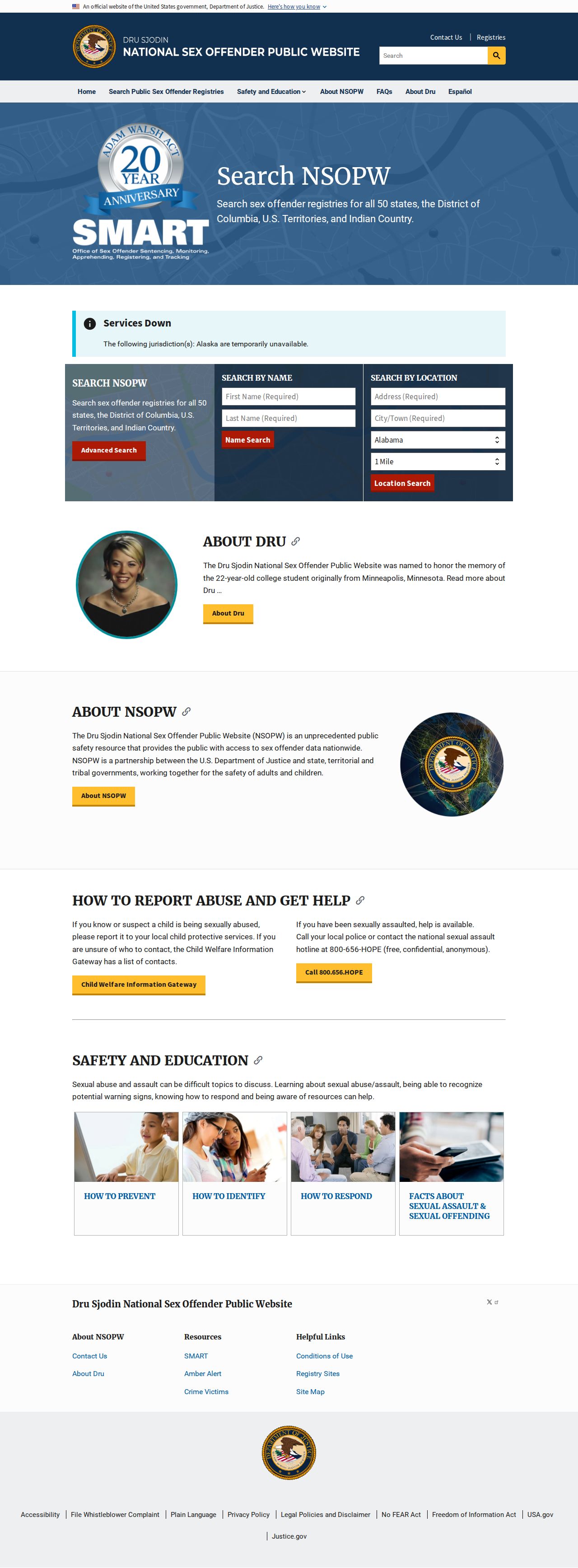
The national interface helps a Carter County searcher widen the scope without relying on a private people-search service. Open the source registry record and read that jurisdiction's current status, terms, and contact details. Kentucky matches should be confirmed through KSP. Another jurisdiction controls its own registration category and public fields.
Carter County Registry 1,000-Foot Rule
KRS Chapter 17 includes Kentucky's sex offender registration laws, and KRS 17.545 contains the state's 1,000-foot residence rule for people within its scope. The statute, the person's qualifying dates, and current court or agency guidance control how that restriction applies. A dot on a registry map is not a land survey, a legal boundary ruling, or proof that a violation has occurred.
For a possible Carter County location issue, record the address and profile status, then contact the sheriff or KSP. Schools, child-care facilities, publicly owned playgrounds, and other places named by current law can raise fact-specific questions about distance and timing. Do not measure from an online map and confront the resident. Law enforcement can check the registration file, the relevant location, and whether the statute applies to that person.
Registration Requirements and Levels in Kentucky
Kentucky does not present its public system as three simple low, medium, and high risk levels. Registration duration is driven by the qualifying offense and KRS 17.500 through 17.580. Public explanations commonly separate 20-year registrants from lifetime registrants. Lifetime registration covers statutory categories that include specified serious, repeat, and child-related offenses. The current statute and the person's record control the result.
| Kentucky Category | Duration | Public Meaning |
|---|---|---|
| 20-year registration | 20 years, subject to statutory calculation and tolling | A qualifying offense falls within the non-lifetime statutory category |
| Lifetime registration | Lifetime | An enumerated serious, repeat, or child-related category applies |
| Noncompliant or absconded | Not a duration category | An enforcement status that should be reported through an official agency |
Reincarceration can affect the running of a registration period under Kentucky's tolling rules. That is one reason a date-based estimate made from a conviction year may be wrong. Federal SORNA tier terms also should not be forced onto a Kentucky profile. For a duration question, use the qualifying offense, present status, and current KRS language rather than a label borrowed from another system.
Carter County Registry Verification Channels
Official Carter County sources do not name a stand-alone sheriff registry desk or publish special registry hours, fees, or appointment rules. The practical local route is the Carter County Sheriff's Office at 300 W. Main Street in Grayson, (606) 474-5616. Posted sheriff hours are Monday through Friday, 8:30 a.m. to 4:00 p.m., and the last Saturday, 8:30 a.m. to noon. Call first and ask where a registration or verification question should go.
KSP Post 14 serves Carter County and can be reached at (606) 928-6421. Use the official Post 14 page to confirm current contact details. These channels support verification and reporting; they are not alternate public profile databases. Bring or relay the profile name, listed address, status, and the specific concern. Do not assume the sheriff holds a separate public list just because it helps administer registration duties.
Report Carter County Registry Concerns Safely
Suspected noncompliance should go to law enforcement without a face-to-face confrontation. Save the public profile URL or identifying fields, note what appears inconsistent, and contact the Carter County Sheriff or KSP Post 14. For an urgent threat or crime in progress, use emergency services. For a routine concern, give the agency enough detail to locate the registry file and explain the issue.
Possible reasons for a mismatch include a recent move, a pending update, an alias, or a wrong search filter. The public cannot decide from a portal screen whether a registration crime occurred. Officers can compare the public display with the nonpublic registration and verification records. This path protects the searcher, the household, and the integrity of an investigation.
Lawful Use and Community Notification
The Carter County sex offender registry supports personal, family, neighborhood, and community safety. A lawful user may review nearby public profiles, confirm an address through official channels, plan age-appropriate family safety steps, or give police a specific concern. Registry data should stay tied to those safety goals. It is not proof of new conduct, a full criminal-history report, or permission for vigilantism.
KSP controls what is made public under Kentucky law. Carter County residents should respect the limits of that disclosure, avoid spreading unverified claims, and use the sheriff or KSP for follow-up. Community awareness works best when the information is read in context and concerns reach trained officers.
KRS 17.580 misuse warning: Using registry information to harass, intimidate, or threaten a registrant or a member of that person's family is prohibited. Kentucky law provides criminal penalties for misuse.